
Available 24/7 at
+86 13632816717

Capacitors in Power Electronics: A Comprehensive Guide
What are capacitors used for? Capacitors, as one of the most fundamental and commonly used passive components in electronic circuits, come in a wide variety of types and parameters. They are widely used in applications such as filtering, energy storage, coupling, voltage stabilization, and many other circuit scenarios. To select the right capacitor easily, it is not enough to look only at capacitance; other key parameters must also be considered. This article will explain the basic knowledge of capacitors, helping you quickly master selection skills.

What are capacitors used for?
Capacitors in power electronics are basic electronic components that store and release electrical charge. They are widely used in circuits for some purposes:
Storing energy
Store electric charge and release it quickly when needed, such as in camera flashes and power backup circuits.
Smoothing & filtering power supply
Stabilize voltage, reduce voltage fluctuations and ripple current in DC power supplies, making power output steady.
Blocking DC, passing AC
Separate direct current from alternating current; allow AC signals to pass while blocking DC flow, commonly used in audio and signal coupling circuits.
Frequency selection & tuning
Work with inductors to form resonant circuits for radio tuning, oscillator circuits and frequency filtering.
Noise reduction & decoupling
Suppress electromagnetic interference and circuit noise, isolate interference between different circuit modules in motherboards and chips.
Timing and delay
Control charge and discharge time to realize time delay functions in timer, switch and control circuits.
How does a Capacitor Work?
Basic Working Principle
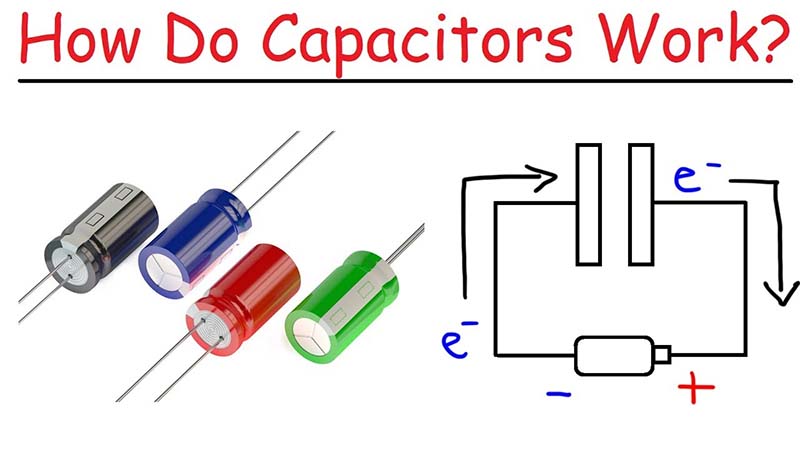
A capacitor stores electric charge, establishes an electric field, blocks DC while allowing AC to pass.
Charging Process
When a capacitor is connected to a DC power source, positive charges from the power supply's positive terminal move toward one plate, while negative charges move toward the other plate. These opposite charges are separated by the insulating dielectric material in the middle and cannot neutralize each other, so they accumulate uniformly on the surfaces of the two plates.
An electric field is formed between the plates, and electrical energy is stored in the form of electrostatic field energy. Under normal conditions, the higher the voltage, the larger the plate area, and the higher the dielectric constant of the material, the more charge the capacitor can store.
Holding State
After charging is complete and the power source is disconnected, the insulating dielectric prevents charge leakage. The charges on the plates remain stable, and the electric field between the plates is maintained. The capacitor thus retains stored energy in a stable state.
Discharging Process
When a conductive wire connects the two plates, a closed circuit is formed. The positive and negative charges on the plates rapidly neutralize and flow directionally through the circuit. The stored electric field energy is released as current.
After discharge, the capacitor returns to its original uncharged state.
DC Blocking & AC Passing
- Blocks DC: After a capacitor is charged by a DC source, charge flow stops and the circuit becomes effectively open. DC cannot continuously pass through the capacitor.
- Passes AC: Since AC continuously changes magnitude and direction, the capacitor undergoes repeated charging and discharging cycles. A continuous current appears in the circuit, making it seem as if AC "passes through" the capacitor.
A capacitor stores electrical energy by accumulating opposite charges on two plates separated by an insulating dielectric, forming an electric field. A DC source only charges it once, after which current is blocked, while an AC source causes continuous charging and discharging due to voltage variation, enabling AC conduction in an equivalent sense.
Parameters and Classification of Capacitors
- Capacitance: Indicates a capacitor's ability to store electric charge. The larger the value, the more electrical energy it can store. Common units include μF, nF, and pF.
- Rated Voltage: The maximum voltage a capacitor can continuously withstand during operation. Exceeding this value may cause breakdown or damage.
- Polarity: Some capacitors are polarized and must be connected with correct positive and negative terminals. Non-polarized capacitors can be installed in either direction.
- ESR (Equivalent Series Resistance): Represents the internal resistance of a capacitor. A lower ESR results in less heat generation and generally better high-frequency performance.
- Leakage Current: A small amount of current loss that still exists after a capacitor is charged. The lower the leakage current, the better the charge retention capability.
- Tolerance: The allowable deviation between the actual capacitance and the rated value, for example ±10%.
- Operating Temperature Range: The temperature range in which the capacitor can operate reliably. A wider or higher temperature rating generally indicates better reliability.
- Frequency Characteristics: Describes how a capacitor performs at different frequencies. Different types of capacitors are suitable for different frequency ranges.
- Ripple Current: The maximum AC ripple current a capacitor can withstand over time. Exceeding this limit may cause overheating and aging.
- Temperature Characteristics: How capacitance changes with temperature (e.g., X7R, X5R, Y5V, NP0).
- Frequency Characteristics: The variation of capacitance and impedance under different operating frequencies.
- Lifetime: The expected stable operating time of a capacitor under specified temperature and conditions, commonly used to describe electrolytic capacitors.
Capacitance
Capacitance is a physical quantity that describes a capacitor's ability to store electric charge. It essentially represents the amount of electric field energy a capacitor can hold.
The standard unit is the farad (F), but this unit is too large for practical circuits, so smaller derived units are commonly used in real applications: mF, μF, nF, and pF.
Unit relationship:
1 F = 10³ mF = 10⁶ μF = 10⁹ nF = 10¹² pF
Surface-mount capacitors often use numeric codes for simplified marking. For example, 104 means:
10 × 10⁴ pF = 100,000 pF = 0.1 μF
Capacitance directly determines circuit function:
- Small values (pF, nF): typically used in high-frequency filtering, resonance circuits, and signal coupling
- Larger values (μF and above): mainly used for power filtering, energy storage, and decoupling
Capacitance is also affected by temperature, operating frequency, and DC bias voltage. These variations are especially significant in ceramic capacitors. In electrolytic capacitors, capacitance may gradually decrease due to aging.
Tolerance (Capacitance Accuracy)
Tolerance refers to the allowable deviation between a capacitor's actual capacitance and its rated value, also known as capacitance deviation. It is expressed as a percentage.
Common tolerance grades include:
- High precision: ±1%
- General precision: ±5%
- Standard commercial: ±10%
- Economy grade: ±20%
- Some older or low-cost ceramic capacitors may even have asymmetric tolerances such as −20% to +80%
Tolerance directly affects circuit stability. In sensitive applications such as resonance circuits, clock oscillators, and precision signal sampling, low-tolerance precision capacitors are required. For general power filtering and bypass decoupling, ±10% or ±20% is usually sufficient.
Tolerance is also closely related to dielectric material:
- NP0 / C0G ceramics: high precision, very stable, low tolerance
- Y5V / Z5U ceramics: large tolerance and significant temperature drift, suitable only for non-critical applications

Understanding the ESR of Capacitors
Equivalent Series Resistance (ESR) is one of the most important yet often overlooked parameters of a capacitor. It represents the small internal resistance that appears in series with the ideal capacitance value.
What is ESR in a Capacitor?
In simple terms, ESR is the resistive component inside a capacitor that causes energy loss when alternating current flows through it. Even though capacitors are designed to store and release energy, the presence of ESR means that some of this energy is dissipated as heat.
You can think of a real capacitor as an ideal capacitor in series with a small resistor-that resistor is the ESR.
Why ESR is important for Capacitors?
Power supply circuits: High ESR leads to greater power loss and heat generation.
Switching power supplies (SMPS): ESR affects ripple voltage and overall output stability.
High-frequency applications: Even small ESR values can degrade signal integrity.
Lifespan of components: Higher ESR often leads to faster aging due to heat stress.
Factors Affecting ESR
Capacitor type: Electrolytic capacitors typically have higher ESR than ceramic or film capacitors.
Frequency: ESR changes with operating frequency.
Temperature: ESR increases at low temperatures in many capacitor types.
Age: As capacitors degrade over time, ESR tends to increase.

Different Types of Power Capacitors
Power Film Capacitors
Made of plastic film dielectric, low loss, high insulation, good frequency and temperature stability. Widely used for power factor correction, harmonic filtering, inverter and power electronic circuits.
Power Electrolytic Capacitors
Including aluminum electrolytic and screw-terminal large-size electrolytic types. Large capacitance, low cost, mainly used for DC bus filtering, energy storage in industrial power supplies, inverters and converters.
Ceramic Power Capacitors
High voltage high-power MLCC or disc ceramic types, with good high-frequency performance, small ESR. Applied in high voltage bypass, high frequency filtering and surge absorption.
Safety Capacitors (X & Y Capacitors)
Specially designed for EMI suppression in AC power systems. X capacitors for line-to-line suppression, Y capacitors for line-to-ground interference, widely used in household appliances and power equipment.
Oil-Filled Power Capacitors
Metal shell filled with insulating oil, high voltage and large capacity, strong heat dissipation and explosion-proof performance. Mainly used in high-voltage power grid reactive power compensation and industrial high-voltage equipment.
Supercapacitors / Ultracapacitors
Ultra-high energy storage capacity, fast charge and discharge. Used for power backup, peak power compensation and energy recovery in industrial and automotive systems.
Capacitor Package Types
Through-Hole Package
Capacitors are mounted by inserting their leads into PCB holes and soldering them. This type offers high mechanical strength and is commonly used in power circuits, electrolytic capacitors, and industrial equipment.
Radial Package
Both leads are located on the same side of the capacitor. This is commonly seen in aluminum electrolytic capacitors and ceramic capacitors.
Axial Package
The two leads are positioned at opposite ends of the component. It is often used in legacy circuits and special installation environments.
Surface-Mount Device (SMD/SMT)
Designed for automated assembly and high-density circuit layouts, widely used in consumer electronics, telecommunications, and automotive electronics. Common types include MLCC multilayer ceramic capacitors, tantalum capacitors, SMD aluminum electrolytic capacitors, and film capacitors.
Screw Terminal Package
Used in high-capacitance and high-current applications. It provides excellent heat dissipation and stability, and is commonly found in industrial power supplies and frequency conversion equipment.
Snap-in Package
Easy to install and securely fixed. It is widely used in high-power power supplies, UPS systems, and energy storage devices.
Power Module Package
Specifically designed for high-power applications, featuring low loss and high voltage resistance. It is commonly used in new energy systems, inverters, electric vehicles, IGBT modules, and high-frequency inverter systems.
DIP Package
A simple structure that is easy to install. It is commonly used for film capacitors, safety capacitors, and other traditional electronic components.
Cylindrical (Can Type) Package
Typically used for aluminum electrolytic capacitors and supercapacitors. It offers large capacitance and good heat dissipation performance.
Box Type Package
Features excellent insulation and high stability. It is commonly used in film capacitors and EMI filtering circuits.

How to Choose the Right Capacitor for a Circuit?
Choosing the right capacitor in 2026 depends on balancing electrical performance, reliability requirements, and the increasing demands of high-frequency and high-efficiency systems such as AI power supplies, EV electronics, and advanced industrial equipment.
1. Capacitance and voltage rating. The capacitor must meet the required energy storage and withstand the maximum circuit voltage with sufficient margin, especially in power conversion and automotive systems where voltage spikes are common.
2. Dielectric type. Ceramic capacitors (MLCC) are widely used for high-frequency decoupling and compact designs, while film capacitors are preferred for high stability, low loss, and power electronics. Electrolytic capacitors are still essential for bulk energy storage in power supplies, though they must be carefully selected for ripple current and lifetime constraints.
3. Temperature and reliability are increasingly important in 2026 applications. Automotive and industrial systems often require components rated for extended temperature ranges (such as -55°C to 125°C or higher) and long operational lifetimes under continuous load.
4. Equivalent series resistance (ESR) and equivalent series inductance (ESL) are critical for high-speed circuits. Low ESR capacitors are preferred in switching power supplies and DC-DC converters to improve efficiency and reduce heat generation.
5. Physical size and packaging. especially in compact electronics and high-density PCB layouts. Surface-mount (SMD) components dominate modern designs, while through-hole and screw-terminal capacitors are still used in high-power or industrial environments.
Finally, application-specific requirements such as EMI suppression, safety certification (X/Y capacitors), and ripple current handling should guide the final selection. In modern systems, choosing the right capacitor is not just about capacitance value, but about optimizing performance, durability, and system-level efficiency.
Eastech rely on a mature supply chain system and long-term partnerships with original manufacturers and authorized distribution channels to ensure traceable product sourcing, a complete range of capacitor models, and continuously competitive pricing with stable delivery capability. We are committed to providing customers with stable and reliable one-stop electronic component supply support, covering MLCC capacitors, aluminum electrolytic capacitors, film capacitors, super-capacitors, as well as various industrial-grade and automotive-grade application products, meeting diverse circuit design and application requirements.
In terms of quality, we strictly implement incoming inspection and quality control processes to ensure that every batch of capacitors meets industry standards in electrical performance, reliability, and consistency. At the same time, we can also provide corresponding technical support and selection recommendations based on customer needs, helping you choose the right capacitor 2026 for circuit design.
As an electronic component supply chain service provider, Eastech will continue to focus on delivering high-reliability, cost-effective electronic component solutions for global customers, helping accelerate R&D implementation and enhance market competitiveness.
Final word, knowing how to choose the right capacitor for a circuit 2026 is essential for ensuring stable performance, efficiency, and reliability in electronic system. By understanding capacitor functions, key parameters, and different types, engineers can make more informed design decisions across power electronics and system applications.
Related information
- 2026.06.09 What is the Best Power Management IC?
- 2026.05.12 What is a Diode in a Circuit?
- 2026.04.26 What is a Transistor and How Does it Work?